
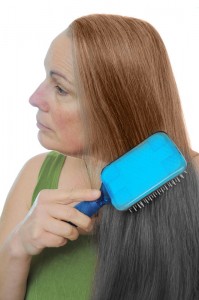
 Have you ever wondered what causes gray hair? Hydrogen Peroxide is one of the culprits:
Senile hair graying: H2O2-mediated oxidative stress affects human hair color by blunting methionine sulfoxide repair.
Wood JM, Decker H, Hartmann H, Chavan B, Rokos H, Spencer JD, Hasse S, Thornton MJ, Shalbaf M, Paus R, Schallreuter KU.
Clinical and Experimental Dermatology/Department of Biomedical Sciences, University of Bradford, Bradford, BD7 1DP, West Yorkshire, UK.
FASEB Journal.2009 Jul;23(7):2065-75. doi: 10.1096/fj.08-125435. Epub 2009 Feb 23.
Abstract
Senile graying of human hair has been the subject of intense research since ancient times. Reactive oxygen species have been implicated in hair follicle melanocyte apoptosis and DNA damage. Here we show for the first time by FT-Raman spectroscopy in vivo that human gray/white scalp hair shafts accumulate hydrogen peroxide H2O2 in millimolar concentrations.
Moreover, we demonstrate almost absent catalase and methionine sulfoxide reductase A and B protein expression via immunofluorescence and Western blot in association with a functional loss of methionine sulfoxide (Met-S=O) repair in the entire gray hair follicle. Accordingly, Met-S=O formation of Met residues, including Met 374 in the active site of tyrosinase, the key enzyme in melanogenesis, limits enzyme functionality, as evidenced by FT-Raman spectroscopy, computer simulation, and enzyme kinetics, which leads to gradual loss of hair color. Notably, under in vitro conditions, Met oxidation can be prevented by L-methionine.
In summary, our data feed the long-voiced, but insufficiently proven, concept of H2O2-induced oxidative damage in the entire human hair follicle, inclusive of the hair shaft, as a key element in senile hair graying, which does not exclusively affect follicle melanocytes.
This new insight could open new strategies for intervention and reversal of the hair graying process.
PMID: 19237503. NIH. NLM. PubMed access to MEDLINE citations
So what can you do about it?
Another study was just released that offers a solution: topical NB-UVB-activated pseudocatalase PC-KUS.This time peroxynitrite (ONOO) is also described as part of the cause. The PC-KUS is also effective for vitiligo, a skin disorder that results in loss of pigmentation.Basic evidence for epidermal H2O2/ONOO–mediated oxidation/nitration in segmental vitiligo is supported by repigmentation of skin and eyelashes after reduction of epidermal H2O2 with topical NB-UVB-activated pseudocatalase PC-KUS.
Basic evidence for epidermal H2O2/ONOO-mediated oxidation/nitration in segmental vitiligo is supported by repigmentation of skin and eyelashes after reduction of epidermal peroxynitrite with topical NB-UVB-activated pseudocatalase PC-KUS.
FASEB Journal. 2013 Apr 29.
Schallreuter KU, Salem MA, Holtz S, Panske A.
Institute for Pigmentary Disorders, E. M. Arndt University, Greifswald, Germany
Abstract
Nonsegmental vitiligo (NSV) is characterized by loss of inherited skin color. The cause of the disease is still unknown despite accumulating in vivo and in vitro evidence of massive epidermal oxidative stress via H2O2 and peroxynitrite (ONOO–) in affected individuals. The most favored hypothesis is based on autoimmune mechanisms.
Strictly segmental vitiligo (SSV) with dermatomal distribution is a rare entity, often associated with stable outcome. Recently, it was documented that this form can be associated with NSV (mixed vitiligo).
We here asked the question whether ROS and possibly ONOO– could be players in the pathogenesis of SSV. Our in situ results demonstrate for the first time epidermal biopterin accumulation together with significantly decreased epidermal catalase, thioredoxin/thioreoxin reductase, and MSRA/MSRB expression. Moreover, we show epidermal ONOO– accumulation. . In vivo FT-Raman spectroscopy reveals the presence of H2O2, methionine sulfoxide, and tryptophan metabolites; i.e., N-formylkynurenine and kynurenine, implying Fenton chemistry in the cascade (n=10).
Validation of the basic data stems from successful repigmentation of skin and eyelashes in affected individuals, regardless of SSV or segmental vitiligo in association with NSV after reduction of epidermal H2O2 (n=5).
Taken together, our contribution strongly supports H2O2/ONOO-mediated stress in the pathogenesis of SSV. Our findings offer new treatment intervention for lost skin and hair color.-Schallreuter, K. U., Salem, M. A. E. L., Holtz, S., Panske, A.
Basic evidence for epidermal H2O2/ONOO–-mediated oxidation/nitration in segmental vitiligo is supported by repigmentation of skin and eyelashes after reduction of epidermal H2O2 with topical NB-UVB-activated pseudocatalase PC-KUS..
PMID: 23629861. NIH, NLM, PubMed access to MEDLINE citations
Dr. Shallreuter’s website offers more information:http://www.homephototherapy.com/pdfs/PC-KUS.pdf
Leave a Reply